
Description
PRODUCT INTRODUCTION
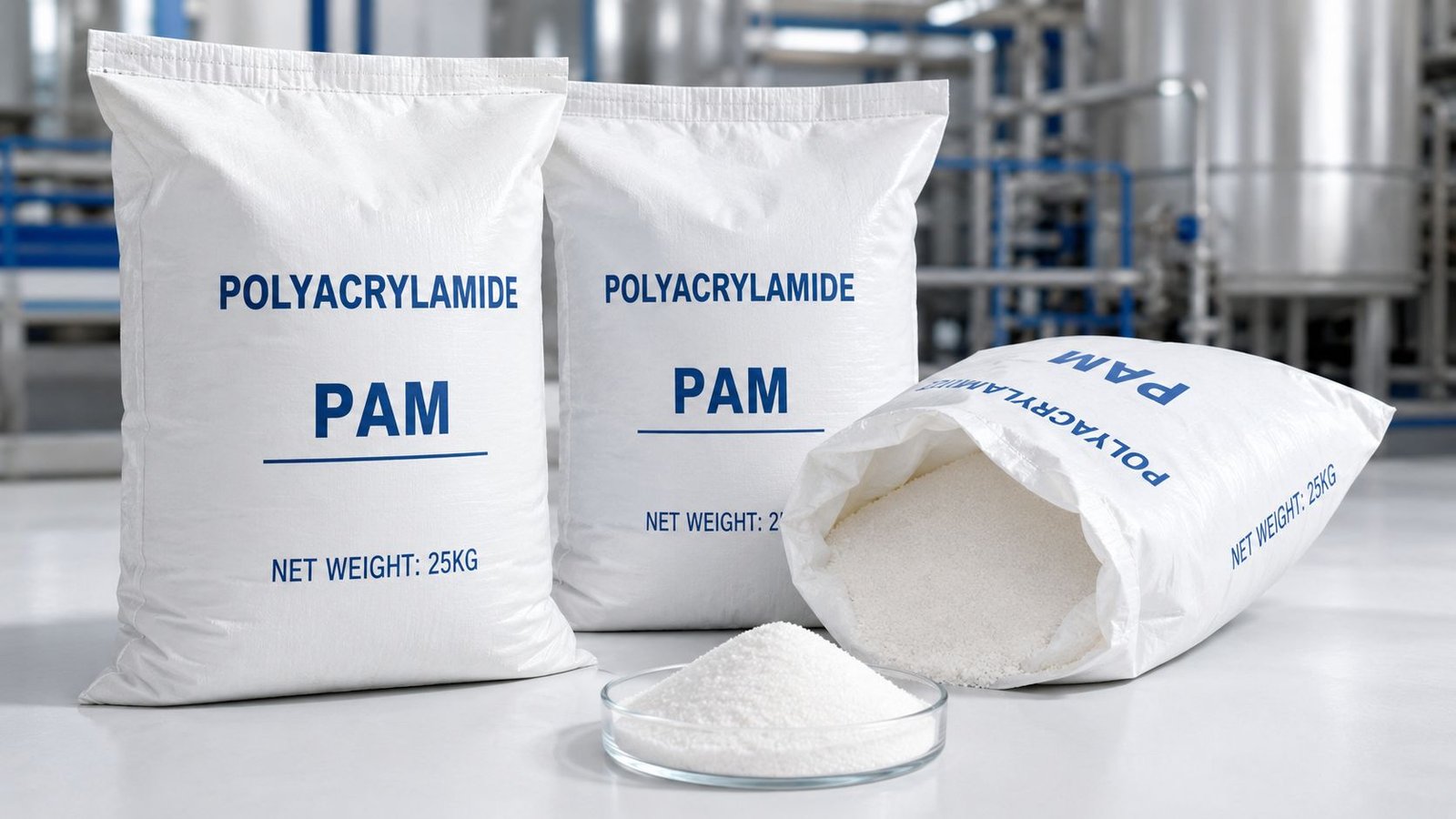
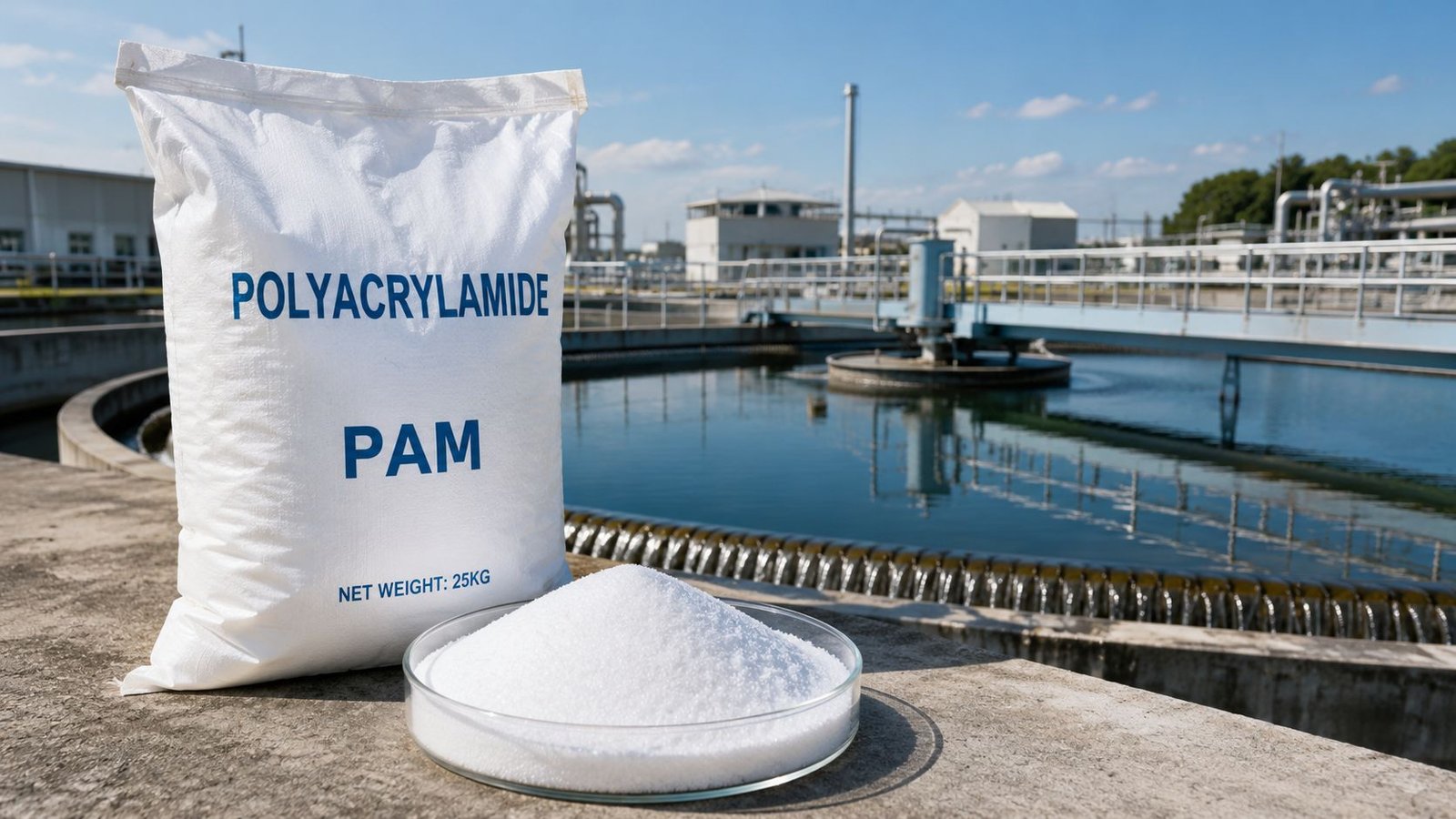
Polyacrylamide (PAM) is a high-molecular-weight, water-soluble polymer widely used as a flocculant and process aid. It improves solid-liquid separation by helping fine suspended particles and colloids form larger flocs that can be settled, floated, filtered or dewatered more efficiently.
EASTKING supplies dry powder grades of anionic PAM (APAM), cationic PAM (CPAM) and nonionic PAM (NPAM) for industrial water treatment, wastewater clarification, sludge dewatering, mining, sand washing, mineral processing, pulp and paper, and related industrial applications. Grade matching, sample supply and factory technical support are available.
Important selection note: PAM is a product family rather than one universal grade. The correct model depends on ionic type, charge density, molecular weight, water or sludge characteristics, treatment equipment and operating conditions.
How Polyacrylamide Works
PAM promotes solid-liquid separation mainly through polymer bridging and, depending on the grade and system, charge interaction. Long polymer chains attach to fine particles and help build larger, stronger flocs. Correct product selection can improve clarification, sedimentation, dissolved-air flotation, filtration and sludge dewatering performance.
Available Product Types
| Type | General Characteristic | Typical Applications |
| Anionic PAM (APAM) | Negative charge; commonly supplied in medium- to high-molecular-weight grades | Industrial water clarification, mineral processing, tailings thickening, sand washing, coal washing, sedimentation and process-water recycling |
| Cationic PAM (CPAM) | Positive charge; available in different cationic charge densities | Municipal and industrial sludge dewatering, biological sludge treatment, paper sludge and selected food-processing sludge |
| Nonionic PAM (NPAM) | Very low ionic charge or near-neutral character | Acidic wastewater, selected mineral processing systems and special solid-liquid separation applications |
Typical Quality Parameters
| Parameter | Typical Website Specification |
| Appearance | White or off-white granular powder |
| Solid Content | ≥88% |
| Dissolution Time | Usually ≤60 minutes under appropriate preparation conditions |
| Residual Acrylamide | Typical export grades may be controlled to ≤0.05%* |
| Molecular Weight | Grade-dependent; confirmed by the selected model and TDS |
| Ionicity / Charge Density | Grade-dependent; selected according to the application |
| Recommended Stock Solution | A common starting concentration for dry powder is approximately 0.1–0.3%, unless the model-specific TDS states otherwise |
Specification statement: The above values describe common dry powder products and are not a universal specification for every PAM grade. The final model, molecular weight, charge density, hydrolysis or cationic degree, viscosity and residual-monomer limit must be confirmed by the supplier’s TDS and batch COA.
*Drinking-water and other sensitive applications may require stricter residual-monomer limits, product certification and compliance with destination-market regulations. No grade should be promoted for drinking-water use unless the specific product is qualified for that application.
MAIN APPLICATIONS
Industrial Wastewater Clarification
- Removal of suspended solids and fine particles.
- Improvement of sedimentation, flotation and filtration efficiency.
- Suitable for selected textile, printing and dyeing, chemical, food-processing, metal-processing and other industrial wastewater systems after grade confirmation.
Sludge Dewatering
- Cationic PAM is commonly used for municipal, biological and industrial sludge dewatering.
- Applicable to centrifuges, belt filter presses, screw presses and plate-and-frame filter presses after model selection.
- Helps improve filtrate clarity and reduce sludge moisture when the correct grade and dosage are selected.
Mining, Sand Washing and Mineral Processing
- Anionic PAM is widely used for tailings thickening, mineral slurry settling, sand washing and process-water recycling.
- Applicable to coal washing, stone processing, metal-mineral processing and related solid-liquid separation systems.
Pulp and Paper
- Used as a retention, drainage, clarification or sludge-treatment aid depending on the selected grade and process.
Municipal Water and Wastewater Treatment
- Used in clarification, sedimentation and sludge dewatering systems.
- Drinking-water applications require a specifically compliant grade and approval under applicable local regulations.
Other Industrial Applications
- Construction slurry, tunneling and foundation engineering.
Selected oilfield, textile, sugar-processing and industrial process-water applications.
Product Selection and Grade Matching
For reliable grade recommendation, customers should provide as much of the following information as possible:
- Application: clarification, sedimentation, flotation, filtration or sludge dewatering;
- Industry and water/sludge source;
- Existing product brand, model, TDS or COA, if available;
- Required ionic type, charge density or molecular-weight range, if already specified;
- Current dosage, treatment result and main operating problem;
- Equipment type, such as settling tank, DAF, centrifuge, belt press or filter press;
- Required quantity, packaging, destination port and country.
For a new application or replacement of an existing brand, sample screening or a jar test is strongly recommended before bulk purchase. EASTKING does not recommend guaranteeing a fixed dosage or treatment result without adequate water/sludge information and application testing.
Preparation and Dosing Guidance
- Use clean water and start controlled agitation before adding the powder.
- Add PAM slowly and evenly into the water. Do not dump a large quantity at one point, as this can cause fish-eyes and agglomeration.
- For dry powder, a 0.1–0.3% stock solution is a common starting range unless the model-specific TDS specifies otherwise.
- Allow sufficient hydration and maturation time. Many grades require approximately 30–60 minutes.
- Avoid excessive high-shear mixing after full dissolution because it can damage the polymer chains.
- Determine the final dosage, solution concentration and dosing point through laboratory or on-site testing.
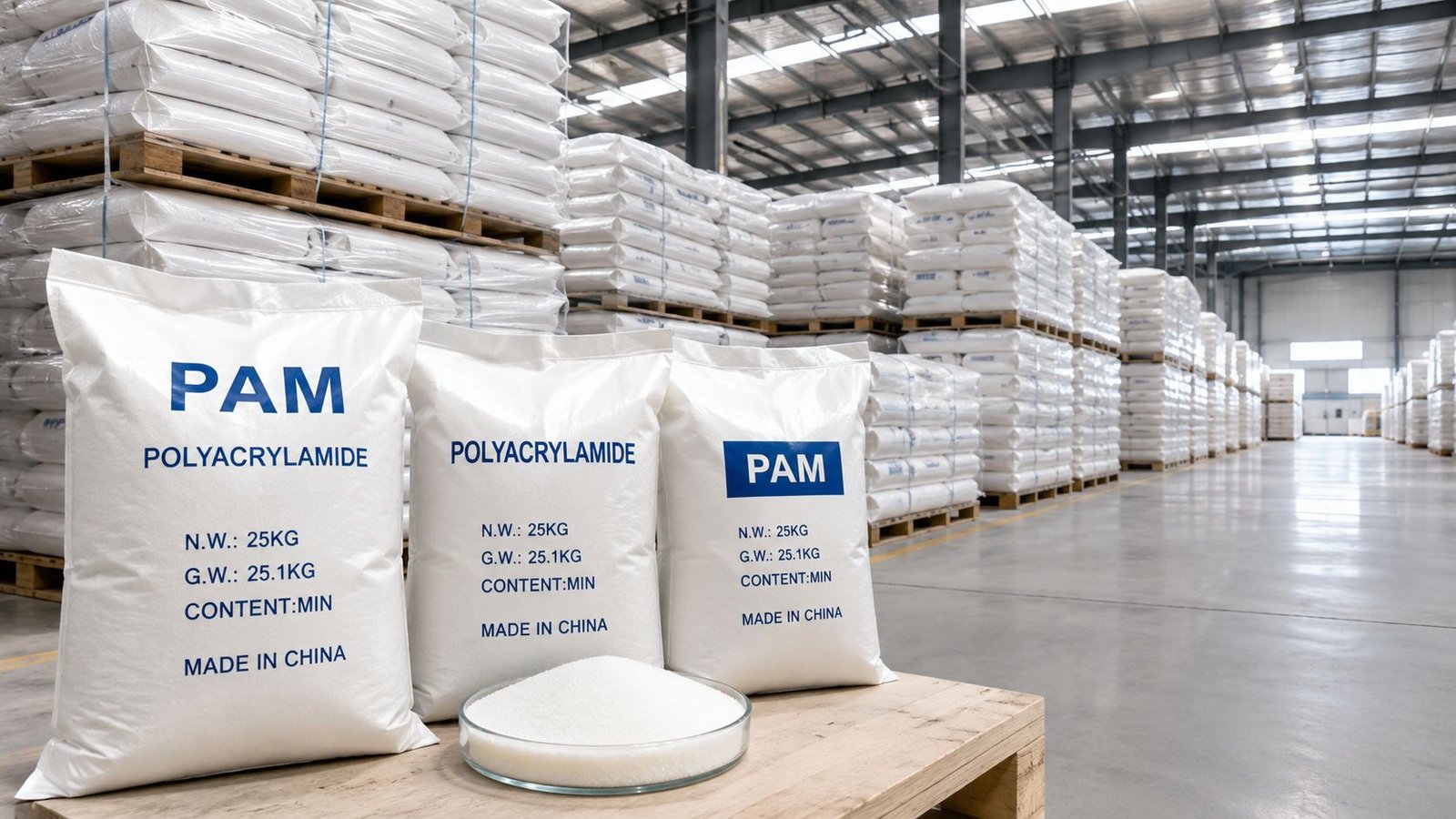
Packaging and Export Supply
| Packaging Option | Description |
| Standard Paper Bag | 25 kg multi-layer paper bag with PE inner liner |
| Standard Woven Bag | 25 kg PP woven bag with PE inner liner |
| Jumbo Bag | 500 kg or 750 kg, subject to grade availability and order confirmation |
| Customization | Neutral packing, customer-brand printing, customized shipping marks, palletized or non-palletized loading |
Container loading quantity must be confirmed according to bag type, pallet use, container payload limits and the actual bulk density of the selected grade.
Storage and Handling
- Store in a cool, dry and well-ventilated warehouse.
- Keep bags sealed and protected from moisture.
- Wet PAM is highly slippery. Collect spills dry where possible and clean the floor carefully.
- Avoid unnecessary dust generation and follow the actual SDS for personal protective equipment and handling requirements.
Why Choose EASTKING
- Anionic, cationic and nonionic dry powder grades available.
- Equivalent-grade matching based on the customer’s current product model or TDS.
- Sample support and factory laboratory assistance for grade screening.
- Export documentation including COA, TDS, SDS, Packing List and Commercial Invoice.
- Stable 25 kg export packaging and containerized supply.
- Neutral packaging, customized shipping marks and OEM bags subject to order quantity.
Frequently Asked Questions
| Question | Answer |
| Is PAM one standard universal product? | No. PAM is a family of products. Anionic, cationic and nonionic grades are further differentiated by molecular weight, charge density and application. |
| Which PAM type is most widely used? | Anionic PAM is widely used in mineral processing, sand washing, clarification and process-water recycling. Cationic PAM is commonly used for municipal and industrial sludge dewatering. |
| Can EASTKING recommend a suitable grade? | Yes. Please provide an existing model or TDS, application details, treatment data and equipment information. Sample screening can be arranged where necessary. |
| Is testing required? | Testing is strongly recommended when replacing an existing brand or selecting PAM for a new application. |
| Can you provide a batch COA? | Yes. The confirmed commercial grade can be supplied with a batch-specific COA. |
| Is PAM a dangerous good? | Common dry powder grades are generally not regulated as dangerous goods, but the final classification depends on the actual formulation and SDS. |
| Can the packaging be customized? | Yes. Neutral bags, customer-brand printing and customized shipping marks can be arranged subject to order quantity. |
| Can PAM be used for drinking-water treatment? | Only a specifically qualified grade that meets applicable certification, regulatory and residual-monomer requirements should be used for drinking-water treatment. |
Request a Quote
Looking for a reliable Polyacrylamide supplier from China? Please provide the required PAM type or current model, application, packaging, quantity, destination port and country. If the exact grade is not known, send us your application details, treatment data and available operating information so that a suitable grade and sample-testing plan can be recommended.
Reviews
There are no reviews yet.